
Your science may be strong. But is its value clear?
Scientific and healthcare companies almost always start with a technology: a new diagnostic approach, a novel therapeutic platform, a medical device, a digital health solution, a more efficient manufacturing process.
The team understands that technology inside and out — its scientific foundations, its technical advantages. Yet the moment they start speaking with customers, partners, or investors, something gets lost in translation.
The problem is rarely the quality of the science. The problem is that its value isn’t immediately understood.
A scientifically impressive innovation doesn’t automatically become a compelling product, a viable business, or an attractive investment. That transition requires understanding how value is perceived, how perception shifts between audiences, and how it should shape positioning, business modelling, and fundraising.
Value is not an intrinsic feature
Companies often describe value through the tangible attributes of their innovation: the number of biomarkers analysed, the accuracy of an algorithm, the speed of a process, the technical specs of a device, the architecture of a platform, the IP behind it.
These elements matter — but they don’t constitute value on their own. Value is a perception.
Think of a smartphone. Its tangible features include storage, screen size, camera, processor, and apps. Yet different people value the same device for entirely different reasons — one sees a productivity tool, another prizes the camera, a third mostly uses it to manage relationships or run a business. The product is identical. The perceived value isn’t.
The same holds for healthcare and life-science innovations. A diagnostic technology might mean higher analytical performance to a laboratory scientist, faster decision-making to a clinician, workflow efficiency to a lab manager, and better resource allocation to a hospital. To an investor, that same technology represents an opportunity to address an underserved market through a differentiated, scalable business model.
The technology doesn’t change. The value being perceived does.
From scientific features to meaningful value
Scientific founders naturally default to explaining what their technology does:
- “Our platform uses AI to analyse medical images.”
- “Our assay detects a broad range of genomic alterations.”
- “Our equipment integrates advanced process analytical technologies.”
These statements describe the solution — they don’t yet explain why it matters. A stronger value proposition connects the technology to a recognised problem and a meaningful outcome, following a simple progression:
Feature → Benefit → Value
Example 1
- Feature: Automated genomic data interpretation
- Benefit: Reduced analysis time
- Value: Faster access to clinically relevant insights, and more efficient use of expert resources
Example 2
- Feature: Real-time monitoring of critical quality attributes
- Benefit: Earlier identification of process variability
- Value: Reduced manufacturing risk, better process understanding, faster production decisions
Features describe the technology. Benefits explain what it enables. Value explains why a specific audience should care. This distinction matters because markets rarely adopt innovations simply because they’re technically superior — they adopt them because the innovation solves an important problem better than the alternatives.
Start with the human problem, not the technology
A compelling value proposition begins with the challenge experienced by the audience:
- Who is facing the problem?
- How important is it to them?
- What happens if it stays unresolved?
- What’s the current alternative — and what does it cost, in time, money, resources, clinical outcomes, or missed opportunities?
This pushes founders beyond “What does our technology do?” toward harder questions: Why does our company exist? What problem are we determined to solve? What’s currently difficult, inefficient, risky, or inaccessible? What changes for our audience if we succeed?
That’s the foundation of effective storytelling — not to oversimplify the science or manufacture emotion, but to make its strategic significance understandable. A clear story usually follows one simple structure:
Context → Tension → Solution → Impact
Context sets the scene. Tension explains why the current approach no longer holds up. Solution introduces the innovation. Impact shows what becomes possible because of it. This is almost always more memorable than a deck built around technical features, nested claims, and dense scientific terminology.
One innovation, several value propositions
A common mistake: developing a single value proposition and repeating it across every channel.
In reality, most companies need one central value proposition supported by audience-specific expressions of that value. Healthcare purchasing decisions involve many stakeholders — clinicians, laboratory professionals, researchers, hospital management, procurement, quality managers, production teams, patients, payers, distributors, strategic partners, investors.
The user of a solution may not be the buyer. The buyer may not be the final decision-maker. The person who benefits may not be the person who pays. Each stakeholder evaluates value through a different lens:
- A clinician prioritises the quality and speed of information behind a clinical decision.
- A lab manager focuses on workflow integration, turnaround time, and resource use.
- A hospital weighs cost, organisational impact, and clinical outcomes.
- A strategic partner looks for complementarity, market access, and differentiation.
- An investor considers market size, competitive advantage, scalability, adoption barriers, and execution ability.
This is why effective communication starts with a detailed map of the audience: who experiences the problem, who uses the solution, who influences the decision, who signs the purchase order, who controls the budget, who benefits from the result, and who can block adoption. The clearer these roles, the more precisely the value proposition can be adapted.
Two tools for turning assumptions into strategy
The value proposition canvas
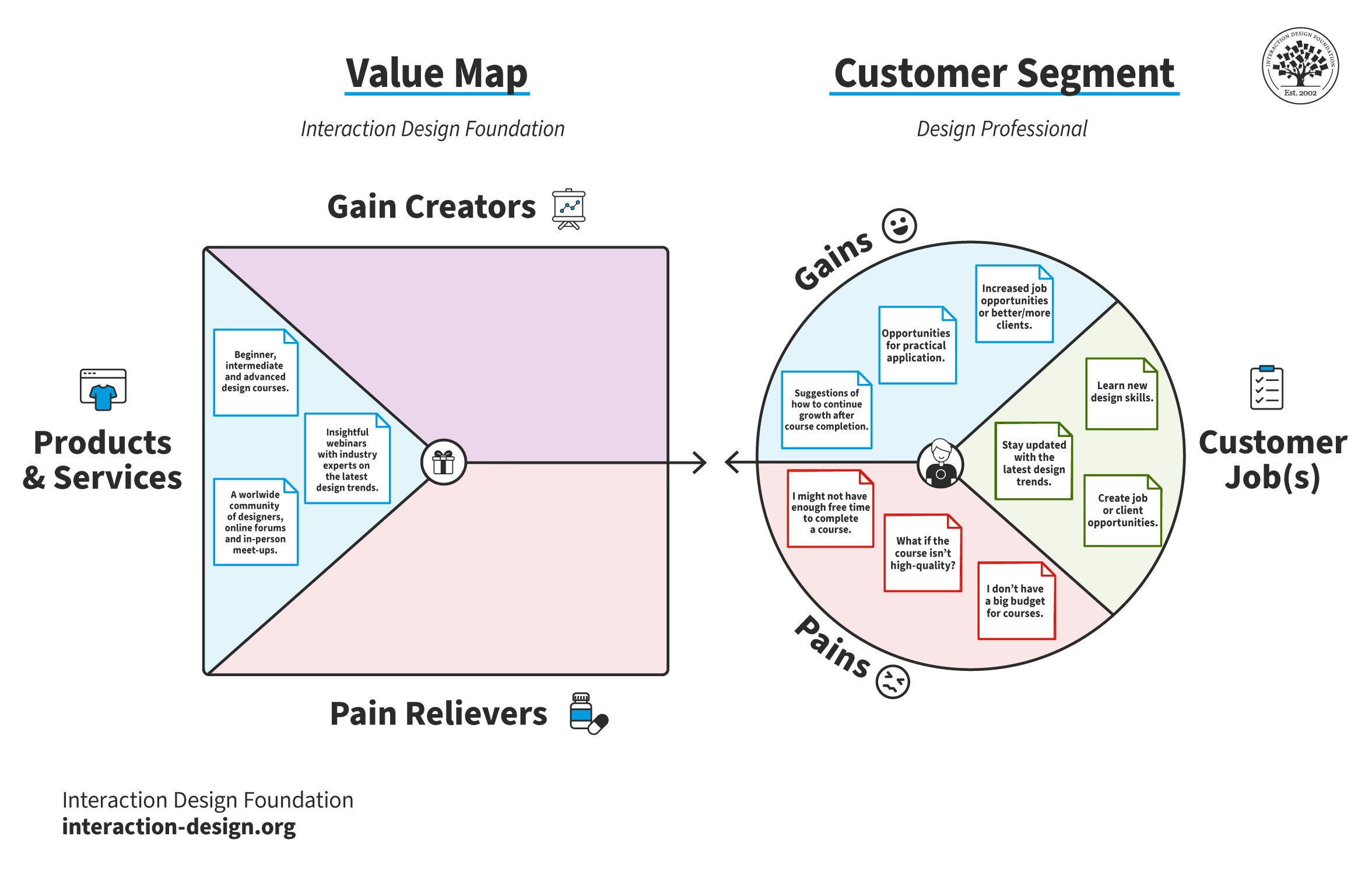
This tool connects a solution to the reality of a specific customer segment. It maps the customer’s jobs to be done, pains, and expected gains against the company’s products and services, pain relievers, and gain creators.
Its real value isn’t the finished diagram — it’s the questions the exercise forces:
- Are the customer’s most important problems clearly understood?
- Are those problems urgent enough to act on?
- Does the proposed solution address a genuine priority?
- Is the company communicating the outcomes customers value — or just the attributes the team is proud of?
Run this exercise separately for each strategic audience. A value proposition built for a researcher shouldn’t be reused unchanged for a hospital executive or an investor.
The business model canvas
This extends the reflection beyond communication into how value is created, delivered, and captured, across nine interconnected elements: customer segments, value propositions, channels, customer relationships, revenue streams, key resources, key activities, key partners, and cost structure.
For scientific companies, this matters because the most technically elegant route to market isn’t always the most commercially realistic one. Should the company sell directly, work through distributors, license the technology, build strategic partnerships, offer a service, sell a product or kit, adopt a subscription model — or combine several of these? Each choice shapes the organisation, commercial resources, financing needs, margins, regulatory pathway, and time to market.
Treat the canvas as a map of strategic assumptions to test, not a static form to fill in:
- Will customers change their existing workflow?
- Is the buying process compatible with the company’s runway?
- Is the identified customer also the budget holder?
- Do distributors have real incentive to prioritise this solution?
- Is pricing aligned with the value created?
- Can the business model scale without a proportional rise in costs?
- What evidence is needed to reduce adoption risk?
A convincing business model isn’t built by filling in nine boxes — it’s built by validating the assumptions behind them.

Connecting value to the go-to-market strategy
Once a company has clarified its target audiences, value proposition, and business model, it can build a coherent go-to-market plan — one that ties together the market opportunity, priority segments, ideal customer profiles, buying triggers, positioning, key messages, proof points, differentiation, channels, sales enablement, performance indicators, and a continuous feedback loop.
These pieces are not independent. The logic cascades:
A vague target segment → a generic value proposition → weak positioning → forgettable communication → harder sales → limited traction → tougher fundraising.
Value proposition, business model, go-to-market, and fundraising are not separate exercises. They are the same strategic logic, expressed at different stages.
Authors: Aubray Prévot (Strategic Marketing & Communication Expert)
